The problem
Florida’s Election Code puts website requirements in many different sections. Some postings must go on your website. Others let you choose your website, the county’s website, or a newspaper. A few have tight timing, like hourly updates on election night or a notice on your home page. After a move to a new website platform, a required page or link can quietly disappear, and nobody notices until someone asks for it.
The prompts
Start in a folder
…\AI Projects\Website Postings Checklist\
Make the folder
On your C: drive, OneDrive, or an external drive. Your choice.
Open it in the app
Claude: Code tab → under the message box, choose Local → Open folder… ChatGPT: open Codex, click Add new project (or press Ctrl+O), then pick the folder. To add more folders later, open the project menu, choose Edit project, then Add folder.
Say what you want
Use the prompt below. Then open what it saved in the folder.
Say them out loud or type them. Change the words to fit your office. The AI goes and gets the public documents itself and saves what it makes in the folder.
Prompt 1 · Say it or type it
Build the checklist and check our site
Go to Online Sunshine, the Florida Legislature's statutes site, and read the current Florida Election Code, chapters 97 through 106, plus section 668.6076. Find every place where the law requires or allows the supervisor of elections or the canvassing board to post something on a website. For anything amended recently, read the History line at the end of the section and tell me which version applies to our next election.

Then go to our office's website at [Web address] and find the page that covers each one. For a page that lists individual voters, like potential-ineligibility notices, just confirm the page is there. Don't open the notices.

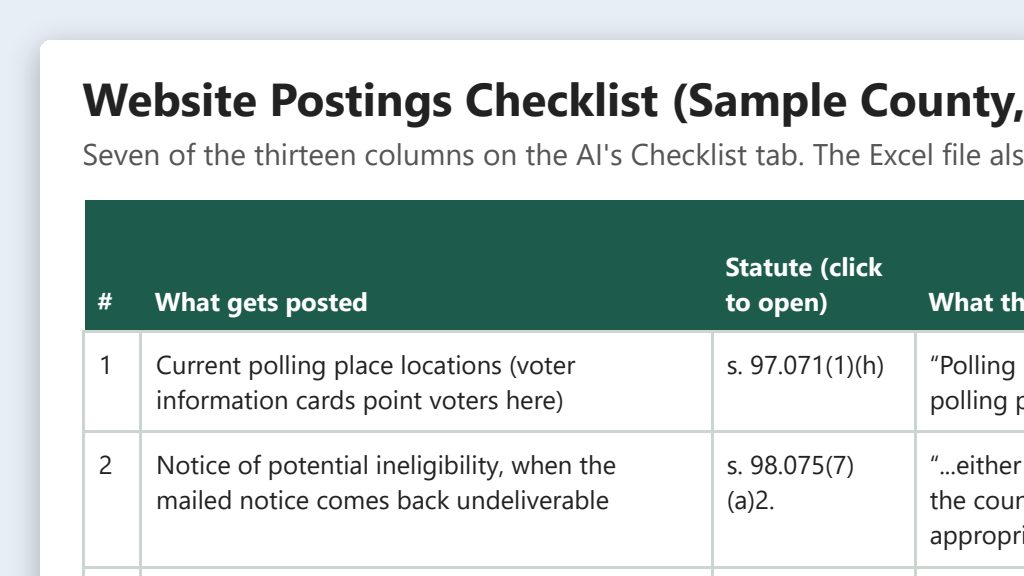
Save an Excel checklist in this folder. For each posting, give me the statute section and subsection with a link, a short quote of the law's words, the timing, whether our website is required or just one of the options, and the page on our site that covers it, or "no page found."
Fill in anything in [brackets] with your own details.
Prompt 2 · Say it or type it
Recheck after a legislative session
The Legislature passed new election laws this year. For each row of the checklist in this folder, read the section's History line on Online Sunshine to find this year's session laws, then open those on laws.flrules.org. Tell me what changed, when it takes effect, and whether it's in effect for our next election.
Prompt 3 · Say it or type it
Recheck after a website move
We just moved to a new website platform, and the old sitemap is in this folder. Check that each old address still lands on the right page. Then check our site against the checklist again and tell me which required pages or links are missing now. For a page that lists individual voters, just confirm it's there.
What you need
- The Claude desktop app (Code tab) or the ChatGPT desktop app (Codex) and a folder called something like
Website Postings Checklist. Put it on the C: drive, OneDrive, or an external drive. - Nothing to download yourself. The AI reads the current statutes on Online Sunshine and your public website. The Florida Election Code is Chapters 97 through 106 (s. 97.011, F.S.). The chapters with the most website requirements are Ch. 98, F.S., Ch. 100, F.S., Ch. 101, F.S., and Ch. 102, F.S.
- Your old sitemap, if you moved to a new website platform: the old sitemap file or a list of old page addresses, saved in the folder. The AI can’t know your old addresses otherwise.
- Your office’s attorney, for a final review.
Step by step
- Make the folder. In File Explorer, create
Website Postings Checklist. - Open it in the app. In the Claude desktop app, open the Code tab, and in the row under the message box choose Local, then Open folder…. In the ChatGPT desktop app, open Codex, click Add new project (or press Ctrl+O), and pick the folder. See Folder projects for the full walkthrough.
- Say the prompt. Speak it or type it.
- Open the checklist it saved and read every row. You know what your office posts and where, so a missing notice or the wrong page stands out. Compare it to the starter checklist below. Where they disagree, click the statute link and read it yourself.
- Look at every “no page found.” Each one is either a gap or a notice you give another way (like a newspaper). Write down which. Some pages show a table from another company inside the page, like petition totals or live turnout, and the AI may not see inside it. Open those pages in your browser before you call anything missing.
- Send it to your attorney with your notes.
- Put the dated items on your election-cycle checklist, so they get tracked with everything else. See Election-cycle website refresh.
- Recheck every year after the legislative session, and after any website platform change (the second and third prompts).
Starter checklist
Required on your website
| Posting | Statute | Timing | Notes |
|---|---|---|---|
| Names of the county canvassing board members | s. 102.141(1), F.S. | When the logic and accuracy test is completed | |
| Expected time the canvassing board will reconvene | s. 102.141(2)(c), F.S. | When a noticed meeting recesses for more than 60 minutes. If the board doesn’t reconvene at that time, post at least 2 hours’ notice before it does. | Decide ahead of time who posts this on late canvassing nights. |
| Notice of the post-election voting system audit: date, time, and place | s. 101.591(3), F.S. | Not stated; post before the audit | Must be on your website’s home page, and in four conspicuous places in the county. |
| Live voter turnout data | s. 98.0981(5), F.S. | Election day, updated at least once an hour | The same data goes to the Division of Elections. |
| Vote-by-mail counts: ballots received and ballots still uncounted | s. 102.072, F.S. | Starting at 7 p.m. on election day, at least once an hour while you’re actively counting | |
| Election preparation report | s. 100.032, F.S. | At least 3 months before a general election | At a minimum: expected staffing during early voting, on election day, and after election day, and the expected amount of tabulating equipment at each early voting site and polling place. |
| Vote-by-mail cure affidavit and instructions | s. 101.68(4)(e), F.S. | Ongoing | The same page must show your office’s mailing address, email address, and fax number. Watch the ID list: the instruction wording in s. 101.68(4)(d), F.S. shows a new list of acceptable IDs on Online Sunshine that starts January 1, 2027 (ch. 2026-26). For the November 3, 2026 election, use the current form or the Division’s posted form. Ask your attorney. |
| Provisional ballot cure affidavit and instructions | s. 101.048(6)(e), F.S. | Ongoing | Same: mailing address, email address, and fax number on the page. Same ID-list warning for the instruction wording in s. 101.048(6)(d), F.S. |
| Actual cost of petition signature verification | s. 100.371(14)(f), F.S. | Ongoing. The statute allows an increase each year on March 1. | Two rates: forms received more than 60 days before February 1 of an even-numbered year, and forms received less than 60 days before. |
| Initiative petition signature totals | s. 100.371(14)(g), F.S. | Last day of each month, or last day of each week from December 1 of an odd-numbered year through February 1 | Running totals plus figures for the reporting period, for each proposed amendment. |
| Summary of each initiative financial information statement | s. 100.371(16)(h), F.S. | Not stated | Applies to each supervisor “whose office has a website.” |
| Public records notice about email addresses | s. 668.6076, F.S. | Ongoing, in a conspicuous location | Applies to any agency that has a website and uses email. Wording below. |
The email notice in s. 668.6076, F.S. must read:
Under Florida law, e-mail addresses are public records. If you do not want your e-mail address released in response to a public records request, do not send electronic mail to this entity. Instead, contact this office by phone or in writing.
Your website is one of the allowed options
For these, the law lets you give notice on the county’s website (the county’s official site for legal notices under s. 50.0311, F.S.), on your own website, or in a newspaper. Using your website is one way to comply, not the only way.
| Posting | Statute | Timing | Notes |
|---|---|---|---|
| Canvassing board meetings: members, alternates, time, and place | s. 102.141(2)(b), F.S. | At least 48 hours before | The time must be specific, not a window. If the website you use becomes unavailable (or there’s no newspaper of general circulation in the county), post the notice in at least four conspicuous places. If you post a tentative schedule weeks ahead, ask your attorney whether it counts as the 48-hour notice for each meeting. |
| Public logic and accuracy test: time and place | s. 101.5612(2), F.S. | At least 48 hours before | Same four-places fallback. |
| Polling place change, with a clear description of the new location | s. 101.71(2), F.S. | Not more than 30 days and not fewer than 7 days before the election | Voters must also get a mailed notice at least 14 days before the election. |
| How voters can update their signature | s. 98.077(3), F.S. | At least once each general election year, before the presidential preference primary or the primary, whichever is first | |
| Notice to a potentially ineligible voter whose mailed notice came back undeliverable | s. 98.075(7)(a)2., F.S. and s. 98.075(7)(b)3., F.S. | Within 14 days after the notice comes back. No timing is stated for the (7)(b)3. notices. | Other notices in the removal process can also be published in a newspaper, on the county’s website, or on your website, when they aren’t sent by certified mail. These notices name individual voters. Keep them out of AI tools. |
| Special election or referendum not otherwise provided for | s. 100.342, F.S. | At least 30 days’ notice, published twice: in the fifth week and the third week before the election week | A city’s website is also an option. If the website becomes unavailable, post in at least five places. |
| Special election to fill a vacancy | s. 100.141(3), F.S. | On a website for at least 10 days before qualifying begins (or in a newspaper twice, at least 10 days before) | The Department of State prepares the notice and sends it to you. |
| Notice of general election: offices and vacancies | s. 100.021, F.S. | The department’s newspaper notice runs during the 30 days before qualifying begins | The Department of State is responsible. The statute allows website notice (the Division’s, the county’s, or yours) “as deemed appropriate by the supervisor.” |
| An election rescheduled after an emergency | s. 101.733(2), F.S. | At least 1 week before the rescheduled election | Where practicable, also broadcast as a public service announcement. |
| Combining precincts that have fewer than 25 registered electors of the only party with candidates on the ballot | s. 101.001(2), F.S. | Same as the polling place change row (s. 101.71(2), F.S.) | The supervisor recommends it and the county commissioners approve it. Notice is given the same way as a polling place change. |
Related website duties
- Polling place lookup. The voter information card must include “a link to the supervisor’s website to provide the most current polling place locations” (s. 97.071(1)(h), F.S.). Keep that page current, and keep its web address stable, because it’s printed on cards.
- Vote-by-mail requests. The law lists “through the supervisor’s website” as one way a voter may request a vote-by-mail ballot (s. 101.62(1)(a), F.S.).
- Public records custodian contact. Post your custodian of public records’ contact information in the main building where your office creates and receives records, and on your website. The statute doesn’t give an order to post. It says what happens if you don’t: a person who sues over a records request then doesn’t have to send you a written notice and wait 5 business days first (s. 119.12(2), F.S.). Ask your attorney what counts as “prominently posted.”
- Accessibility. The federal web accessibility rule for state and local governments (WCAG 2.1 Level AA) will apply to these pages on the date for your county’s size. That is April 26, 2027 for 50,000 people or more, and April 26, 2028 for fewer than 50,000. Some older PDFs and archived content are excepted. See Website Management and the ADA.gov fact sheet.
Checked: no website requirement found
We looked for these and didn’t find a statute requiring them on your website. Voters look for most of them there anyway, so they still belong on your election-cycle checklist.
- Sample ballots (s. 101.20, F.S.): published in a newspaper before the election. Instead, you may email them to voters who opted in, or mail them, at least 7 days before the election.
- Early voting sites and hours (s. 101.657, F.S.): provided to the Division of Elections by the 30th day before the election. Daily early voting and vote-by-mail totals must be “made available,” but the statute doesn’t say where.
- Precinct-level results (s. 98.0981(3), F.S.): you submit them to the Department of State, and the department posts them.
- Local campaign finance reports (s. 106.07, F.S.): open to public inspection. No duty to post them on your website was found.
- Notice of access to vote-by-mail materials (s. 101.572(2), F.S.): you “must publish notice” before signature comparison begins, but the statute doesn’t say where.
One possible outcome
One run of the first prompt, against the real 2026 Florida Statutes and a stand-in website for a made-up Sample County.
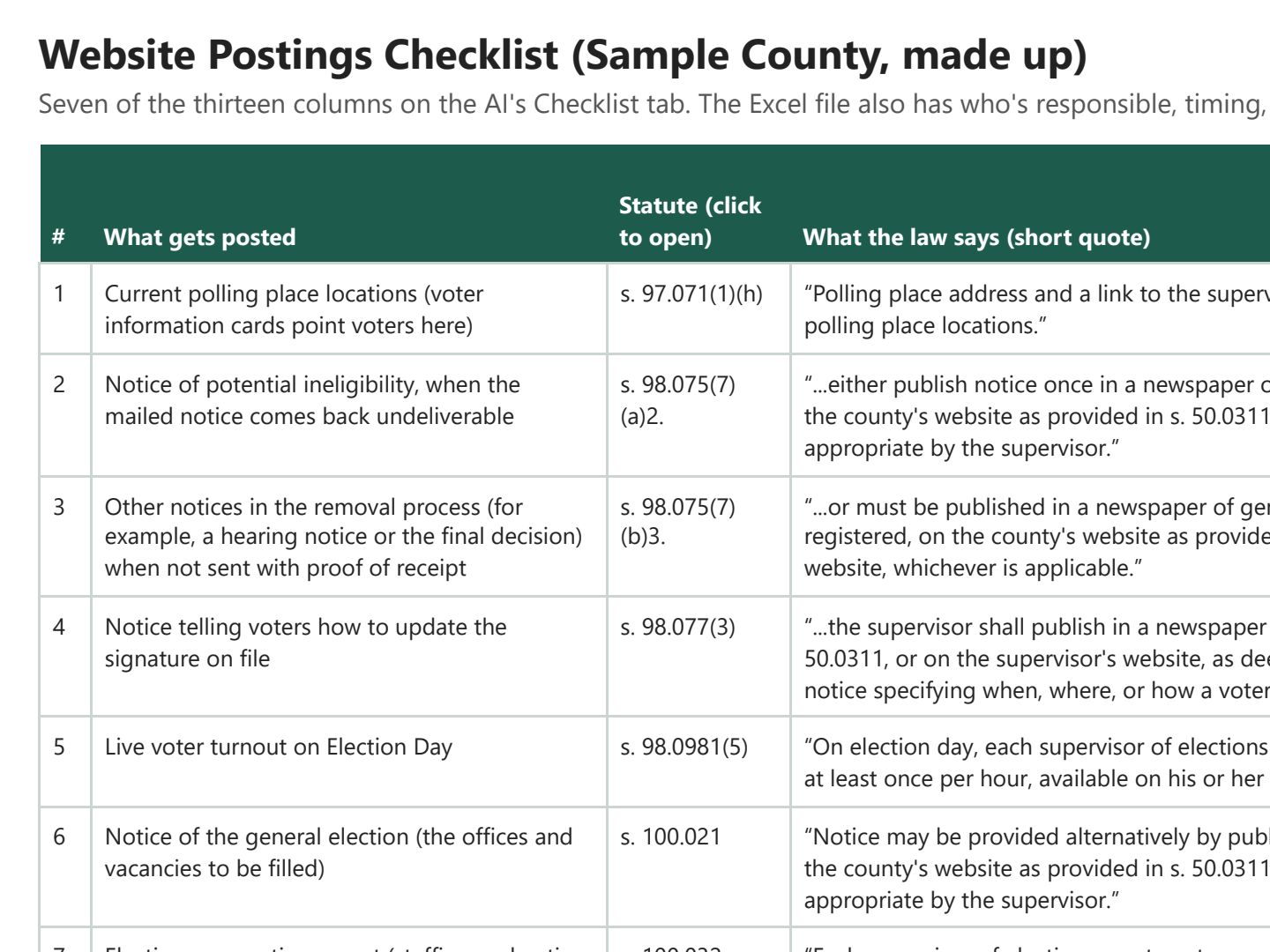 (opens the full version, PDF, 3 pages, 119 KB)
Word, Excel, and PowerPoint files download to your phone; the PDF opens first. File names end in -DRAFT because AI output is a draft until a person checks it. Web addresses shown in these samples are made-up and will not open.
Make it yours
- Plain-language versions. To explain any of these statutes to staff, see Plain-language statute explainers.
- Canvassing board notices. For drafting the notices themselves, see Canvassing board meeting notices.
Time: by hand vs. with AI
By hand
A full day of reading statutes
AI’s part, measured
About 25 minutes
in a test run of these prompts
With AI
About 1 hour, plus attorney review
your time, including review
About the measured time: “AI’s part” is how long the AI took, start to finish, in a test run of these prompts on September 27, 2026. It works on its own while you do something else. “By hand” and “With AI” are estimates of your own time.
Honest estimate. The AI reads the statutes and your site in about 25 minutes. Comparing its checklist to the starter checklist below and reading the statute yourself wherever they differ takes about an hour. Your attorney’s review isn’t included in the hour, and it shouldn’t be skipped.
Checking the work: what an expert looks for
You know this work, so you’re the best person to check it. Open every file it made and read every page. If part of it is outside what you know, hand that part to someone who knows it. These are the spots that most often need a fix:
- This checklist is a starting point, not a legal opinion. Your office’s attorney should confirm it before your office relies on it.
- Online Sunshine can show amended text before it takes effect. The 2026 elections package (ch. 2026-26, Laws of Florida (PDF)) has parts with different effective dates: some on April 1, some on July 1, and some on January 1, 2027. Read the History line at the end of the section, then check the effective-date section of that law before you quote any recently amended section.
- For the ‘option’ rows, pick one method, write it down, and use it every time. That makes it easy to show how notice was given.
- Save a dated copy (a PDF or screenshot) of time-sensitive postings, like canvassing board notices and hourly counts, in case you’re asked what was posted and when. Ask your records management liaison officer (RMLO) how long to keep them.
- The voter information card links to your website for current polling places. If a platform move changed that page’s address, ask your web vendor or IT staff to redirect the old address.
Last reviewed October 2, 2026.